

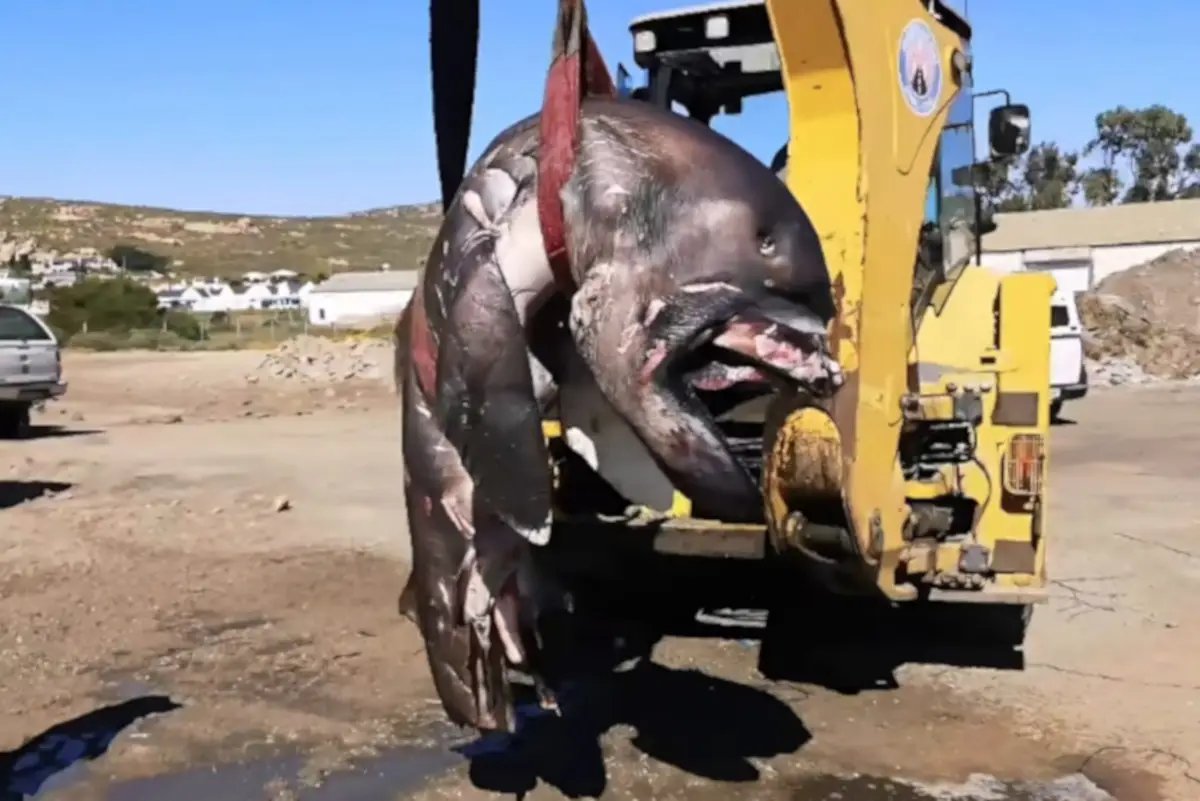

A rarely seen deep-sea shark has washed up near the harbour in St Helena Bay on South Africa’s West Coast, giving researchers an unusual opportunity to study one of the ocean’s most elusive species.
The carcass of a megamouth shark (Megachasma pelagios) was discovered near the Pioneer Fishing fish factory on Saturday, 22 August.
Witnesses reportedly spotted the shark swimming in the harbour shortly before it eventually washed ashore.
The unusual sighting was brought to the attention of Weslander by Velddrif environmental activist Ettienne Swanepoel of the Sandveld Wildlife Rehabilitation Centre (SWERF).
One of the ocean’s rarest sharks
The megamouth shark is a deep-sea species rarely encountered by humans.
It is instantly recognisable by its enormous head and distinctive, rubbery-looking lips. The species can grow to around five metres long.
Despite its intimidating appearance, the megamouth is a filter feeder rather than an active predator.
Like the much larger whale shark and basking shark, it swims with its mouth open, filtering tiny organisms from seawater.
Its diet can include krill, jellyfish, shrimp larvae, small crustaceans and crab larvae.
Researchers rush to examine carcass
While the discovery attracted plenty of attention from curious onlookers, it also presented an important scientific opportunity.
The carcass was kept at the fish factory while two senior researchers from the Department of Forestry, Fisheries and the Environment (DFFE) travelled from Cape Town to examine it.
Researchers Sarika Singh and Steven McCue collected samples from the shark, which will be taken to the department’s laboratory in Cape Town for further analysis.
Among the questions researchers hope to answer is what caused the animal’s death.
Once the examination and sampling process has been completed, the carcass will be buried.
Only the second found in South African waters
The discovery is particularly significant because megamouth sharks are so rarely encountered.
According to Singh, this is only the second megamouth shark to have been found in South African waters.
The species was first discovered in 1976, when the first known specimen was caught off Hawaii.
Since then, only around 300 sightings or specimens have been recorded worldwide, according to the information provided.
That makes every encounter valuable to researchers trying to understand the biology, behaviour and distribution of the elusive species.
View this post on Instagram
A post shared by wildlifedecoded (@wildlifedecoded1)
An extraordinary West Coast sighting
The appearance of the deep-sea shark in a relatively shallow harbour environment is what made the St Helena Bay discovery particularly unusual.
For local residents, the sighting provided a rare glimpse of a species that spends much of its life far from the surface.
For scientists, however, the carcass could offer something even more valuable: an opportunity to learn more about one of the world’s least understood sharks.
The samples collected in St Helena Bay could ultimately help researchers determine more about the animal’s condition and possible cause of death.
For now, the rare megamouth’s unexpected visit to the West Coast has given South Africans an extraordinary encounter with one of the ocean’s most mysterious creatures.
READ | Shark kills man on Australia’s Great Barrier Reef