
WARNING: The following article may contain images that may be disturbing to sensitive readers. Reader discretion is advised.
The Cape of Good Hope SPCA has welcomed the conviction of Mark George after a failed tail-docking incident left a young Boerboel named Max with a blackened, infected tail that required urgent amputation.
READ | SPCA welcomes conviction of Cape Town man who threw dog from fourth-floor flat
The smell of dead tissue
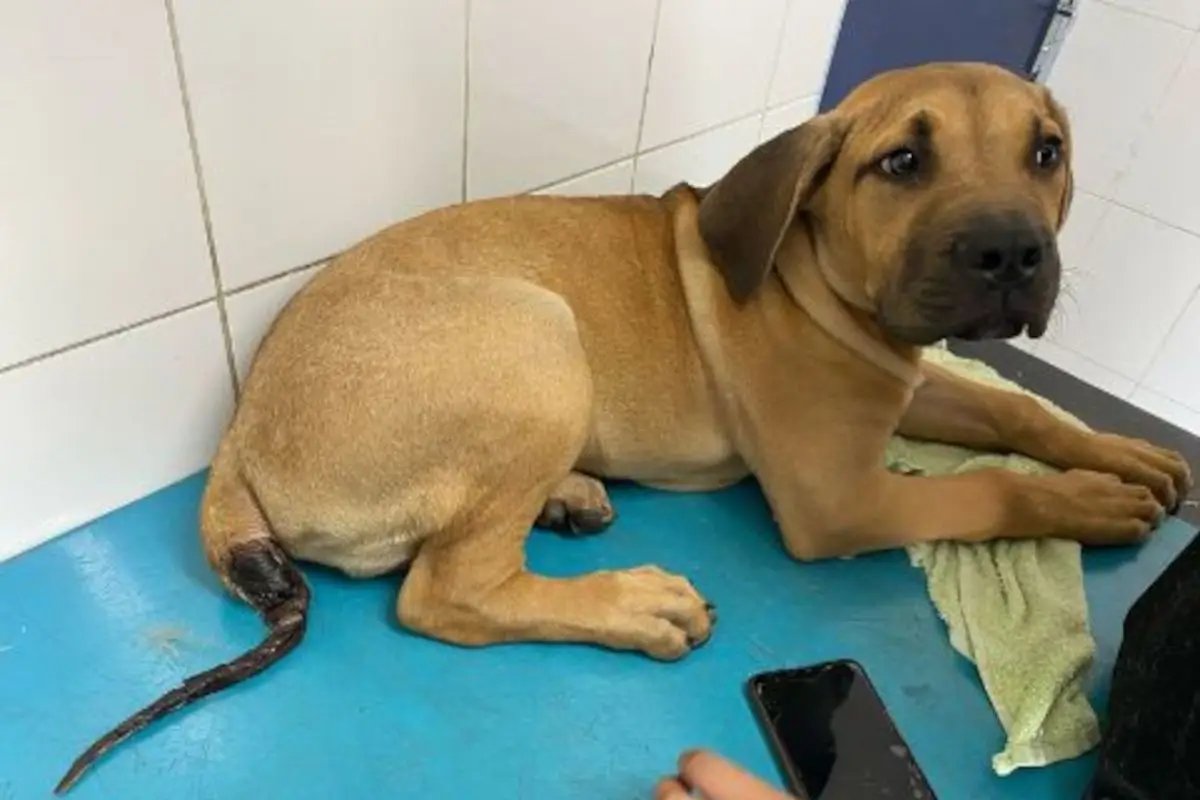
Inspector Rudolph Philander smelled the dead tissue before he saw the puppy. Inside a consultation room at the Cape of Good Hope SPCA hospital, five-month-old Max stood on an examination table. Much of his tail had turned black. A deep wound cut across it near the base. The damage was so extensive that urgent surgery was needed to remove the dying tissue and prevent sepsis.
“Before I even saw Max, I could smell the dead tissue. No puppy should have to endure that suffering. Max was one of the lucky ones we could treat and rehome. We welcome this conviction because animals depend on us to act, and to see these cases through,” says Inspector Philander of the Cape of Good Hope SPCA.
Owner convicted in Muizenberg
George, 62, was convicted on 27 October 2026 in the Muizenberg Magistrates’ Court and sentenced to a fine of R20 000 or 12 months’ imprisonment, wholly suspended for five years.
The suspension is conditional on him not being convicted of an offence under Section 2(1)(a) of the Animals Protection Act committed during that period.
The Cape of Good Hope SPCA welcomes the verdict and the accountability it brings for Max’s suffering; however, it should have been direct imprisonment.
Most of his tail had died
When Max arrived at the SPCA on 24 February 2025, examining veterinarian Dr D Narotam found that approximately 80% of his tail was necrotic: the tissue had died.
The tail was infected and emitted a foul odour. There was severe muscle wasting, and Max no longer had sensation in the far end of his tail.
A deep laceration extended halfway through the tail near its base. X-rays also revealed distortion of the tail vertebrae. These were severe injuries in a puppy whose life had barely begun.
The injuries contradicted the explanation
The explanation offered by George was that Max had been biting his tail because of fleas and that a bandage and elastic had been applied to stop him.
The veterinary findings challenged that account.
Dr Narotam recorded only a mild flea burden, with no hair loss or skin irritation. In the veterinarian’s assessment, the injuries were inconsistent with a dog biting its own tail.
Instead, the report described a failed tail-docking incident as “highly likely”. The injuries also indicated that the tail had probably been constricted or tied off near its base, causing the tissue beyond that point to die.
Although the history given suggested a recent injury, the muscle wasting and tissue death indicated that the wound had been present for a prolonged period, possibly more than a week.
Urgent amputation to prevent sepsis
Inspector Philander seized Max on suspicion of illegal tail docking, securing the puppy’s access to treatment.
Max was placed on a drip and given intravenous antibiotics and pain relief. His severely damaged tail required urgent amputation to prevent sepsis and improve his welfare.
Because the injury was so close to the base, the veterinarian had to perform a very high amputation. So little healthy tissue remained that the surgical wound required close monitoring for breakdown.
One of the lucky ones
After surgery, Max’s demeanour improved dramatically. The veterinary report described him as playful and confirmed that he could pass urine and faeces successfully.
Max was one of the lucky ones. The Cape of Good Hope SPCA was able to intervene, provide the treatment he urgently needed and rehome him.
He received a second chance in a new home. The loss of his tail, however, is permanent.
Max, who now goes by Duke, has found his happily ever after! ❤️
Despite everything he endured, Duke’s story has a beautiful ending.
He has found his forever home with a loving family who have given him the second chance he so desperately deserved.
The SPCA – and The South African website – extends its heartfelt thanks to Duke’s new family for opening their hearts and home to him.
After all the pain and suffering he experienced, Duke can now look forward to a life filled with love, kindness and the security of knowing he will never have to suffer like that again.
From Max’s painful past to Duke’s bright future, this is the happy ending every animal deserves.
Tail docking is maiming
Routine cosmetic tail docking constitutes maiming under Section 2(1)(a) of the Animals Protection Act 71 of 1962.
The South African Veterinary Council does not condone routine tail docking. It distinguishes cosmetic docking from amputation performed for medical reasons, such as treating injury or disease.
Max’s case exposes the suffering behind this practice: damaged tissue, infection and a puppy needing urgent surgery.
The Cape of Good Hope SPCA welcomes this conviction and urges the public to report suspected animal cruelty.
For an animal suffering out of sight, that report can be the first step towards treatment, protection and a second chance.