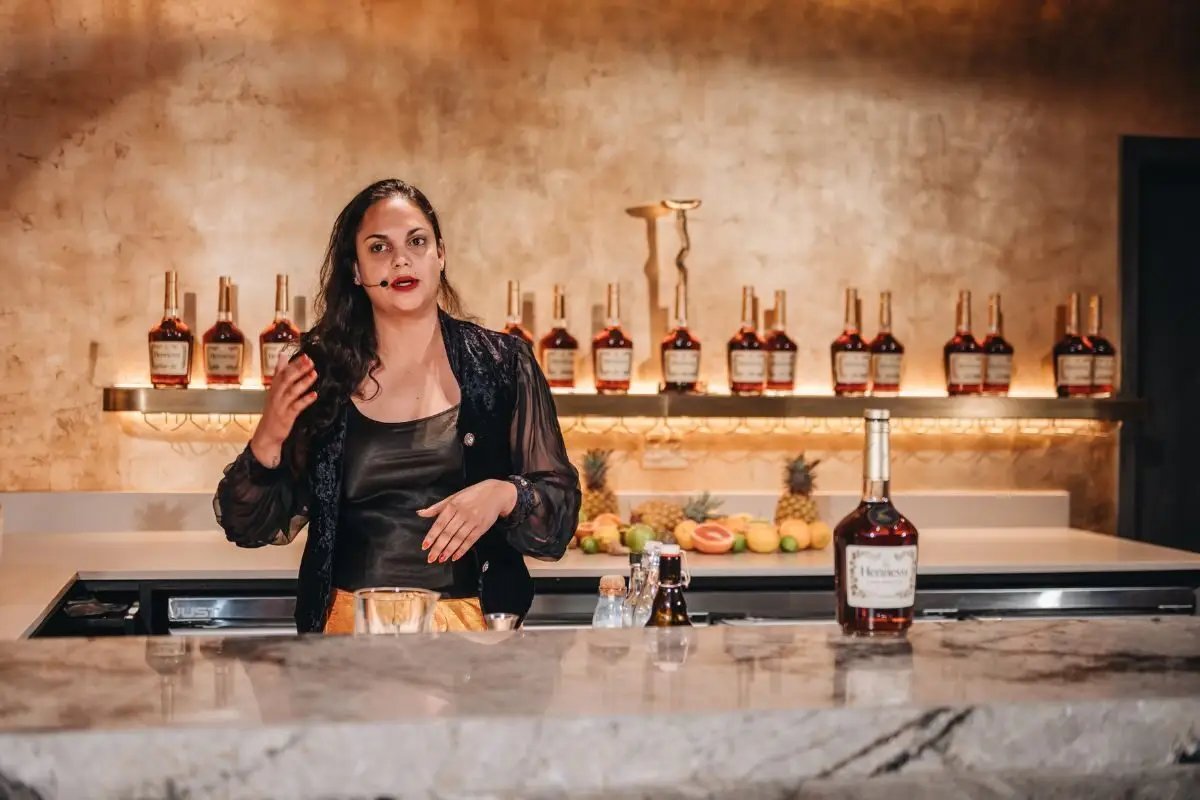

There’s a moment at every good South African braai when the smoke drifts over the fire, someone passes the biltong around, and a stranger stops being a stranger. Roxanne Read has spent years trying to get that feeling into a glass.
Now the 40-year-old bartender from the European Bartender School and Drinks & Co Bar is taking it to the world. Named one of “Africa’s next mixology icons”, Read is a Hennessy MyWay finalist and will represent South Africa and the continent at the competition’s Global Finals.
This is a woman who once performed on stage and turned the bar into a new one. She talks about cocktails the way some people talk about theatre. “It’s craft, it’s art, it’s performance, it’s storytelling,” she says. “It’s a way of saying, ‘This is how I see the world.’”
A brief to sink her teeth into
Like most competitions she enters, MyWay started for Read with “a healthy dose of competitiveness”. She loves being handed a spirit and the freedom to ask: “Okay, but what would I do with this?”
Winning the first round changed the stakes. She dug into Hennessy’s history and found a house with a long relationship with artists and creative expression. For someone who grew up performing, she says, “it felt like a match made in heaven.”
The Africa round, she admits, “knocked me sideways in the best possible way.” She had underestimated the talent across the continent. Competitors came from different places but shared one goal: to put something deeply personal into their work.
The biggest surprise, though, was closer to home. Preparing to represent South Africa forced her to ask what it really means to be South African. “Suddenly, the answers are everywhere,” she says. They are in “our music, our food, our humour, our traditions, our resilience and the way we gather and tell stories.”
“I thought I was proudly South African before,” she adds. “But this journey has made me realise just how deeply that identity runs through me.”
“Why Hennessy?” The question that changed everything
The turning point came from the judges. “Why Hennessy? Why not another cognac?”
“And I remember thinking, ‘Sh*t. They’re right. Why?’” Read laughs. She could make a beautiful cocktail with plenty of great cognacs. So what made this one belong with her story?
The question sent her down a rabbit hole. She studied Hennessy’s links to artists and its philosophy of transformation, and then looked just as hard at her own life.
Until then, she says, she had always made a great drink and built a story around it. Now the order flipped. “I found myself thinking, ‘I hope this cocktail is good enough to stand alongside what I’m trying to say.’”
She stopped asking how to make an impressive drink. Instead she asked: “What do I have to say, and how can this spirit help me say it?”
“If the story doesn’t mean something, the cocktail is just a cocktail,” she says. “But when the two have a reason to exist together? That’s when the craft becomes something much bigger than what’s in the glass.”
Shakers where her mouth is
Read is nearly 20 years into an industry long dominated by men. For the first half of her career, she believed she had to be “harder, stronger, faster and better” than the men around her just to earn her place.
Somewhere along the way, she realised earning her place was only the beginning.
The “mixology icon” title, she says, is a reminder that she has the experience, the voice and the craft to carry that responsibility. “I’m not here to talk about what needs to change. I can put my shakers where my mouth is.”
The female perspective will feature in her upcoming round, though she won’t say how. “I’ll keep my lips sealed on that for now!”
The timing matters too. For the first time, she feels she has the maturity and grounding to understand the weight of the role. “I spent years fighting to prove I deserved a place,” she says. “Now, I want to help create a space where the women coming after me don’t have to fight quite so hard to find theirs.”
A very big table, with room for everybody
South Africa is often called a melting pot. Read prefers another picture: “a very big table with room for everybody.”
For her, the country’s magic is its instinct to connect. It’s the way you can turn to a stranger, ask “Howzit, bro, how’s your day going?” and actually stop to hear the answer.
Nothing captures that better than a braai. “It’s not just about the food or the fire; it’s about what happens around it,” she says. “Friends become family, strangers become friends, stories get told, and everybody has a place.”
That nostalgic smell of braai smoke turns up in her cocktails again and again. “It represents something much bigger than flavour,” she says. “It represents belonging.”
She keeps returning to pineapple and lychee too. They’re found all over the world, but she says they “just hit differently in South Africa” because of the memories they carry.
And then there’s biltong. “I genuinely feel that if I don’t offer someone biltong, I’m at risk of losing my South African stripes!” she jokes. To her, it’s the ultimate olive branch: pass a bowl around a braai and suddenly everyone is reaching in and chatting.
She believes the world has barely started on Africa’s larder. She points to indigenous ingredients, regional spirits, fermentation and preservation methods, and the way smoke and fire transform food. Baobab, marula and hibiscus all excite her. But the real opportunity, she says, is to understand the stories and knowledge behind these ingredients, “rather than simply treating them as the next big trend.”
Loud, playful and unapologetically ourselves
Ask Read what the world expects from African cocktail culture and she won’t pretend to know. But she knows what Africa brings: “soul, passion, colour, energy and a whole lot of personality.”
Pushing boundaries, for her, isn’t about chasing trends or showing off the fanciest techniques. It’s about people, and a continent with “an incredible instinct to find reasons to celebrate, even when life gives us plenty of reasons not to.”
“We can be technically brilliant, absolutely,” she says. “But we can also be loud, playful, colourful, emotional and unapologetically ourselves.”
She thinks the scene has reached “a bloody exciting point”. Bartenders are waking up to the raw ingredients, local products and creativity around them. More people now see hospitality, distilling and mixology as serious careers and businesses, not just passions.
Technology and global techniques are sharpening those skills. But Read is firm that learning from the world doesn’t mean copying it. “We don’t need to squeeze ourselves into somebody else’s idea of world-class,” she says.
What sets African bartenders apart? Resourcefulness, first. Many have worked without the funding, equipment or training available elsewhere. Now, as doors open, she describes the mood as: “Look what I can do with what I’ve got. Now imagine what I can do with the opportunities you’ve had all along.”
Then there’s the humour, and the ability to get through red tape and hard times together. “We know how to acknowledge that something was difficult, dust ourselves off and say, ‘Right. That was sh*t. Now, who’s ready to celebrate?’”
Open hands, a full glass
So what is she packing for the Global Finals? “The South African gees,” she says. That means the resilience and humour, and the ability to find light in the darkest places. Above all, she wants to bring generosity.
Expect “a big, bold South African serve”, plus a gift that lets the judges take a piece of home with them. “It’s my way of saying, ‘Here, have a taste of where I come from. There’s plenty to share.’”
In five years, she hopes people will stop asking whether African cocktail culture can compete. She wants them to ask what the global industry can learn from it instead.
Her own part in that future is about people, especially young women entering the trade. She wants to open doors, amplify female voices and pass on the hard lessons so others don’t repeat her mistakes. “I don’t just want a seat at the table,” she says. “I want to help build a bigger table, with more seats, more voices, and a bloody good drink in everyone’s hand.”
Her advice to young South African bartenders is simple. Hospitality is about seeing and hearing people. “It’s not just an after-school job,” she says. It will exhaust you and scare you, but it builds resilience for life.
And don’t get so caught up in overseas trends that you forget who you are. “We are not America. We are not the UK,” she says. “We have our own people, products, terroirs, stories and an almost endless amount of inspiration right here at home.”
Her parting words are a challenge to the whole industry. “The world is starting to look at us. So what are we going to say?”
Not for sale to persons under the age of 18. Enjoy responsibly.