

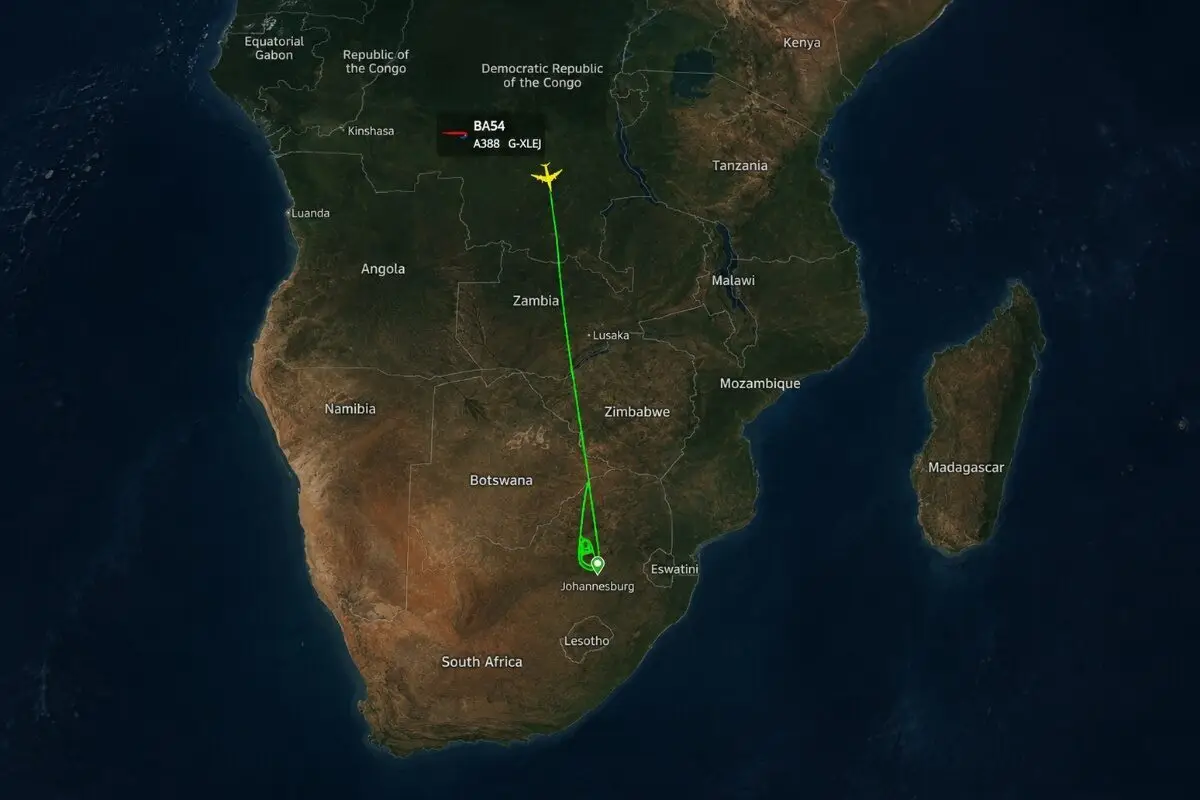

Passengers aboard a British Airways Airbus A380 endured a seven-hour flight to nowhere after the superjumbo was forced to turn around over Central Africa.
Flight BA54 was due to leave O.R. Tambo International Airport at 21:15 on Friday, 7 August. However, ground delays of more than five hours pushed its eventual departure to 02:36 on Saturday.
The A380, registered G-XLEJ, climbed to 34 000 feet and headed north towards London Heathrow. It spent more than two hours flying over Botswana and Zambia before reaching the Democratic Republic of Congo.
It was there that the crew detected a malfunction with the aircraft’s weather radar system, writes Air Live.
Flight to nowhere
With the A380 unable to continue its planned route, the crew made the decision to turn back towards Joburg. The aircraft had already been airborne for several hours.
According to an update on Simple Flying, the airline’s ground team in Joburg noted how the weather radar briefly displayed a warning message after takeoff, which eventually cleared.
However, the “dense clutter” on the radar scope never dissipated. This makes it useless in detecting rain, ice, or storm fronts.
“Malfunctioning weather radar might sound minor compared to an engine failure, but in long-haul aviation, it is considered a critical no-go scenario,” writes Luke Diaz.
“The ACARS message shows that the crew attempted to proceed with the backup system, but it was inoperative.”
The total absence of weather radar left the pilots on flight BA54 with no choice but to land the plane.
I guess going back to Joburg is better than diverting to Brazzaville?
Faulty weather radar for BA this time, so hardly something to warrant getting on the ground quickly, but also not something you’d want to go through ITCZ without!!! https://t.co/AdJUuUDVEy— Analytic Flying (@analyticflying) August 8, 2026
Dumping fuel
The fully-fuelled superjumbo was too heavy to land immediately after turning around. The crew therefore descended to 25 000 feet after reaching northern South Africa and entered a holding pattern just north of Johannesburg.
The aircraft spent roughly two hours circling the area while burning fuel. This allowed it to reach its safe maximum landing weight.
The A380 eventually touched down at Joburg’s O.R. Tambo almost seven hours after its initial departure. All passengers and crew returned to the terminal without incident.
Second time lucky
The aircraft then underwent maintenance checks and repairs to its weather radar system.
Later that evening, G-XLEJ was cleared to fly again. It departed Joburg as BA54 at 22:48 SAST on 8 August, just over an hour after the scheduled departure time for that evening.
This time, there was no dramatic U-turn on the flight.
The A380 successfully completed its journey to London Heathrow without further disruption, bringing the extraordinary round trip to an end.