

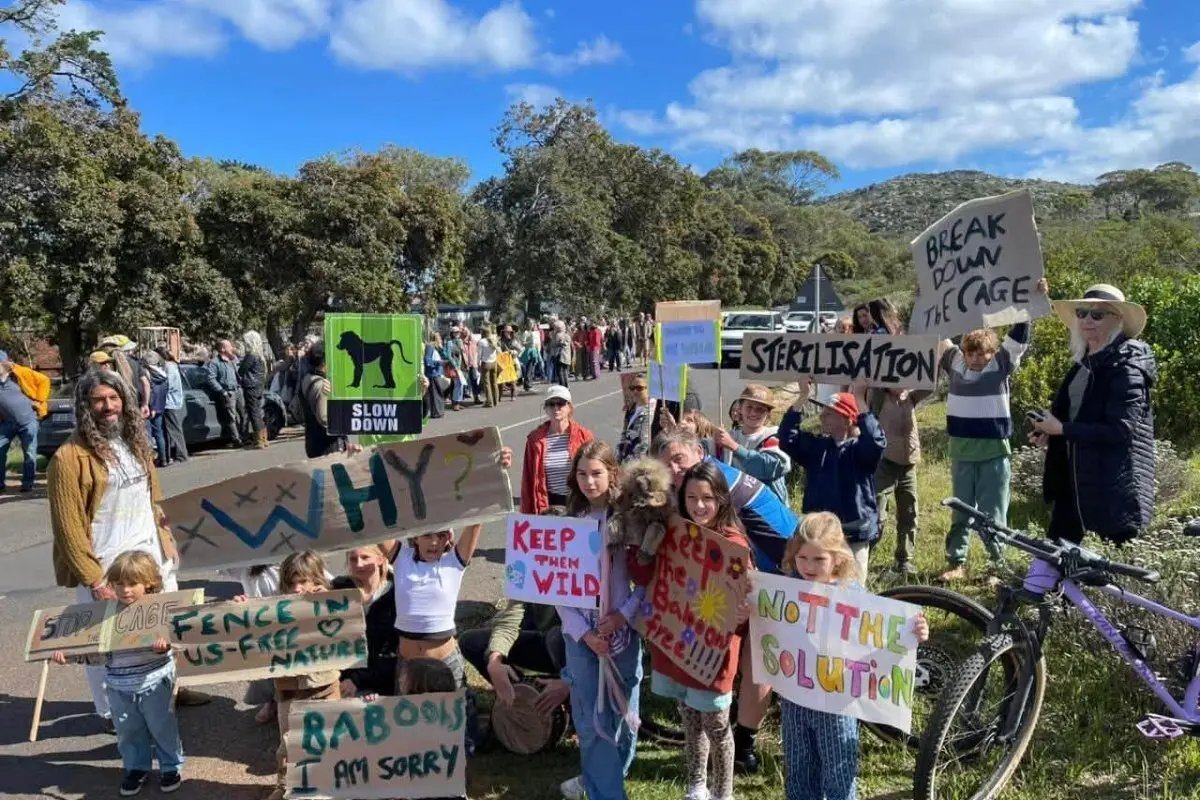

Residents and wildlife supporters in Cape Town’s South Peninsula are mounting a final push to stop two local baboon troops from being removed from the wild and placed in captivity.
A silent protest was held in Scarborough on Sunday, with families and children gathering near the newly-built Urban Wildlife Centre.
The famed ‘Waterfall’ and ‘Seaforth’ baboon troops are due to be permanently removed and housed at the facility, just a few kilometres from Scarborough.
The Waterfall troop’s relocation is scheduled for September 2026.
According to the Green Group – Simonstown, some of the protesters broke their silence, calling out: “We love baboons. Keep them free.”
In an uncanny twist, the Groot Olifantsbos troop later arrived at the Centre. The baboons rummaged through unsecured rubbish bins before climbing into the enclosures intended for the Simon’s Town troops.
Baboons face a choice between captivity and conflict
The planned removals form part of the approved Cape Peninsula Baboon Management Action Plan, consisting of representatives from SANParks, CapeNature, and the City of Cape Town.
Cape Peninsula Baboon Management Joint Task Team member Greg Oelofse says authorities believe they are faced with two difficult options: culling the troops or moving them into a sanctuary.
“It’s not something that we really want to do,” Oelofse told CapeTalk. “It’s…what we consider the best choice of two bad choices.”
The Sanctuary has drawn criticism from zoologist Dr Dave Gaynor, who argues that fencing could provide a non-lethal alternative.
Gaynor says he has secured funding for a fence around the wider Simon’s Town area. His proposal would keep baboons out of residential areas while allowing them to remain wild.
Oelofse, however, says a fence would not solve the underlying problem. He estimates construction would cost between R25 million and R30 million, excluding maintenance and security.
“The primary reason we’re not advocating…for a fence in Simon’s Town is that there isn’t enough lowland habitat to support those troops,” he added.
He also warned that displaced baboons could simply move into neighbouring areas, shifting the conflict rather than solving it.
A fight over the future of Cape Town’s wild primates
Gaynor’s latest proposal, published in the Daily Maverick, extends beyond Simon’s Town.
He has called for strategic fencing and upgrades around military land, as well as improvements to the Slangkop troop’s habitat boundary.
He argues that physical barriers could prevent the primates from accessing residential and commercial areas without removing them from the wild.
The sanctuary plan would instead see the Waterfall and Seaforth troops live out their lives in purpose-built enclosures. Breeding would not be permitted, with healthy males due to be vasectomised.
Oelofse defended the approach by highlighting the dangers baboons face in urban areas, including being pepper-sprayed, attacked by dogs, hit by vehicles and shot with pellet guns.
“We want to just allow these baboons to live out their lives in peace,” he said.
No easy solution
For the protesters in Scarborough, the issue is more fundamental: whether wild baboons should remain part of the Cape Peninsula’s landscape and biodiversity.
Authorities maintain that rising human-baboon conflict is exposing the animals to increasing danger while creating serious challenges for nearby communities.
Last year a large male baboon made its way up the peninsula and wreaked havoc in Cape Town’s southern suburbs. Read more on that story here.