

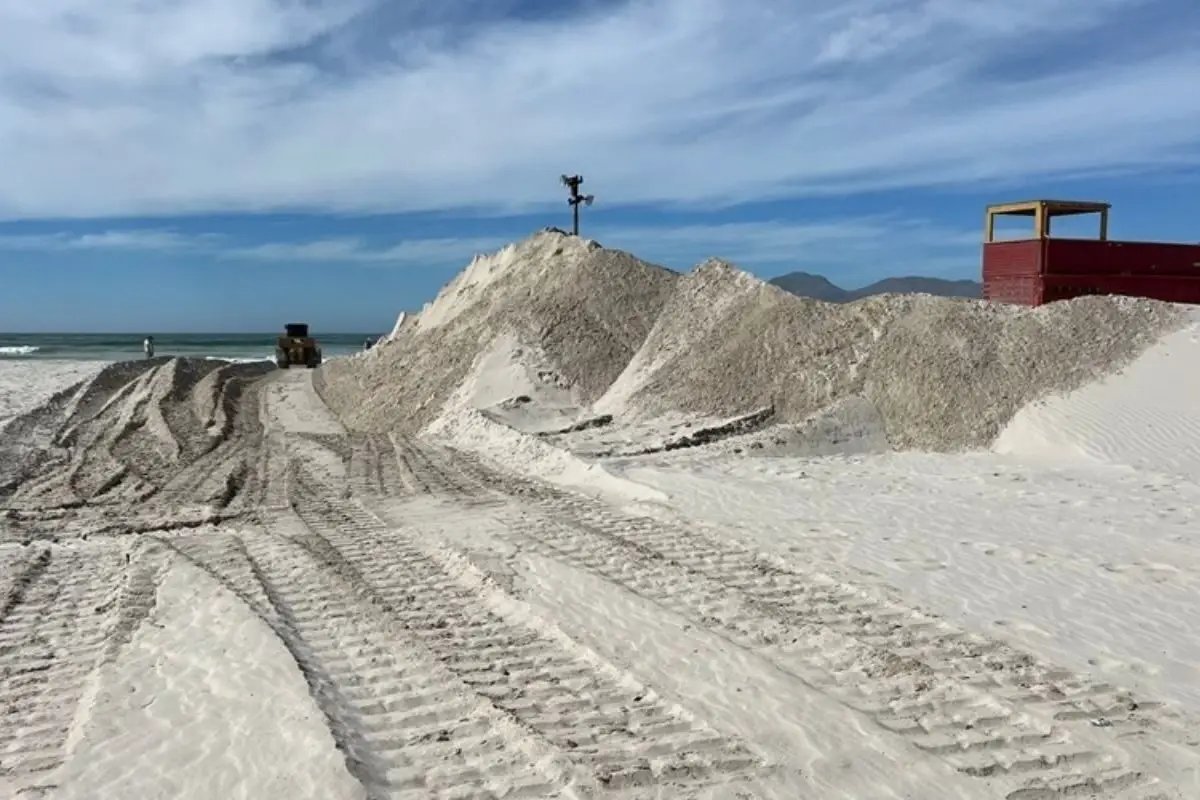

The sight of bulldozers moving large amounts of sand along a beach can understandably leave beachgoers wondering what is going on.
But it’s known as beach lowering or re-profiling, and Cape Town carries out the work before summer at selected beaches along its coastline.
But what does beach lowering actually involve, and why does the City deliberately move sand towards the sea?
What is beach lowering?
Beach lowering is essentially the reshaping of a beach by moving sand from higher parts of the beach towards the low-water mark.
The City uses a combination of mechanical and manual methods to move the sand.
But the sand isn’t simply removed and taken away.
Instead, it’s pushed down towards the water, where waves and tides can redistribute it through the natural coastal system.
The City describes the process as mimicking a natural scour event, something that occurs naturally along shorelines.
So while the beach may look different while the work is taking place, the objective isn’t to permanently remove sand from the coastline.
So, why does Cape Town lower its beaches?
The main reason is windblown sand.
Cape Town experiences strong south-easterly winds during summer, and large quantities of dry sand can be picked up and blown away from the beach.
This can become a problem when beaches are located close to roads, parking areas and other infrastructure.
By lowering the beach, a greater area can become wet during high tide.
Wet sand is less susceptible to being blown around by strong winds, helping to keep more of the sand on the beach rather than allowing it to accumulate on nearby infrastructure.
The City says this is particularly important because the affected areas are highly altered coastal systems, where urban development is located close to natural coastal processes.
It is not the same as removing sand from a beach
One of the important things to understand about beach lowering is that the sand remains part of the coastal system.
The City moves the sand towards the low-water mark, after which wave action transports it back into circulation.
This is why the programme is different from simply removing sand from a beach or transporting it somewhere else.
The aim is to change the beach profile, rather than permanently reduce the amount of sand in the coastal system.
Timing is also a major part of the programme.
Cape Town’s strongest south-easterly winds occur during the warmer months, creating the greatest risk of windblown sand affecting nearby infrastructure.
The City therefore carries out the work before the peak summer season.
This year, work is scheduled to begin on 1 October 2026, with a provisional completion date of mid-November, ahead of the busy festive season.
The 2026 programme covers three beaches.
At Muizenberg, the work will run from the Zandvlei River mouth to the Muizenberg Pavilion.
Work at Fish Hoek will take place from Jager’s Walk, in front of the Galley Restaurant, to the lifesaving building.
At Hout Bay, the work will take place adjacent to Beach Road.
The beaches will remain open to the public during the work.